
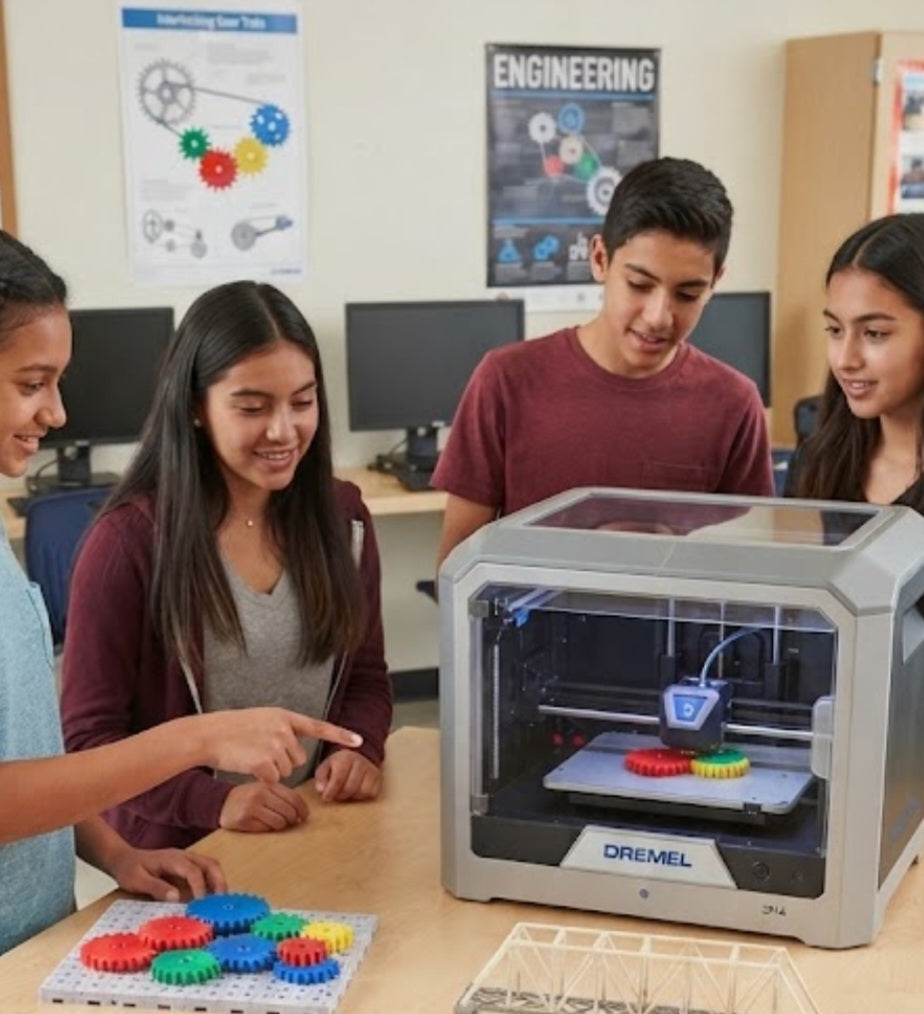
Integrating 3D printing into a school curriculum can often feel daunting when educators worry about time constraints and lengthy print schedules. Because standard educational periods usually last between 45 and 60 minutes, waiting hours for a complex model to finish printing simply isn't practical. To successfully engage students without disrupting the school timetable, technology teachers need fast-printing exercises that demonstrate core engineering, geometry, or physics principles while completing well within a single lesson.
The Interlocking Gear Train:
Teach basic mechanical advantage and gear ratios by having students print small, thin-profile spur gears that snap together on a peg board and rotate immediately off the bed.
The Structural Torture Test Bridge:
Explore material science and tensile strength by printing miniature bridge trusses with sparse infill, letting students test load capacities right at their desks before the bell rings.
The Custom Lithophane Keytag:
Combine digital graphics and raster depth mapping by having learners export miniature keychains featuring their initials with variable-thickness shadow relief.
The Snap-Fit Geometric Puzzle:
Demonstrate dimensional tolerance and friction fits by printing interlocking polygon pieces that must snap together precisely without requiring glue or post-processing.
Designing a successful single-period lesson plan requires shifting the focus away from massive, multi-hour prints and toward rapid, high-impact demonstrations. By adjusting your slicer settings—such as utilizing a 0.6\text{mm} nozzle width, printing with a single perimeter wall, and setting infill down to 10%—you can slash print times for small educational models to under 15 minutes. This allows students to prepare their CAD files or inspect pre-sliced gcode, watch the first vital layers weld onto the build plate, and still have ample time to analyze the finished physical object during class discussion.
Implementing these fast-paced modules transforms the 3D printer from an intimidating industrial machine into an active, hands-on teaching aid that fits seamlessly into standard school scheduling. When learners can immediately hold, test, and critique a mechanical component they helped conceptualize, abstract textbook theories instantly turn into concrete engineering intuition.


