
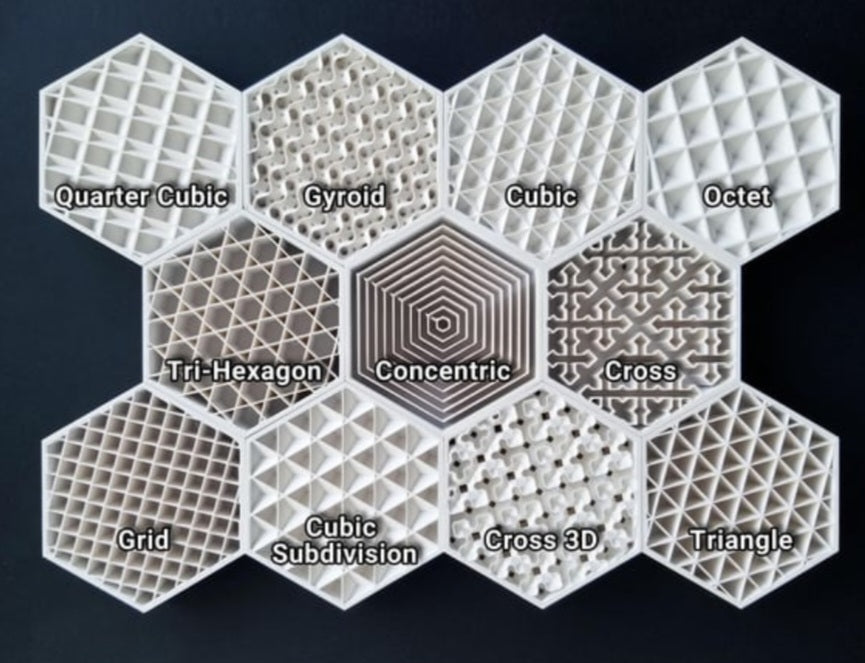
When slicing a 3D model, picking the right infill pattern is just as important as choosing your density percentage. The internal geometry dictates how your part handles stress, absorbs impacts, and distributes weight across multiple axes.
Understanding the unique structural characteristics of different patterns will help you select the ideal configuration for your next print.
Gyroid Infill
Known for its wavy, organic appearance, the gyroid pattern has become a favorite among advanced makers for its exceptional all-around performance.
Best Used For:
Flexible parts, water-tight containers, multi-directional load-bearing components, and general everyday printing.
Pros:
Offers true isotropic strength (equal strength in all directions), excellent weight-to-strength ratio, and prints smoothly without self-intersection or nozzle collisions.
Cons:
Slicers can take slightly longer to compute complex toolpaths for intricate gyroid curves.
Grid Infill
The classic default in many slicing programs, grid infill creates a straightforward intersecting square matrix layer by layer.
Best Used For:
Rapid prototypes, simple decorative models, and fast everyday drafts.
Pros:
Extremely fast to calculate, very quick to print, and provides rigid support for top solid layers.
Cons:
Lines intersect at the same Z-height within each layer, which can cause the nozzle to collide or catch on previously extruded plastic, potentially leading to vibrations or print failure. It also lacks true multi-axis structural reinforcement.
Cubic Infill
Composed of stacked, diagonal repeating cubes, cubic infill delivers robust 3D structural integrity.
Best Used For:
Heavy-duty mechanical parts, functional brackets, structural prototypes, and items subjected to high compressive loads.
Pros:
Provides fantastic true three-dimensional strength and distributes heavy vertical and horizontal forces evenly throughout the core.
Cons:
Uses slightly more filament and takes longer to print than simple 2D patterns like grid.
Selecting the right internal geometry ensures your parts withstand real-world mechanical demands without wasting extra time or material on inefficient structures.


