
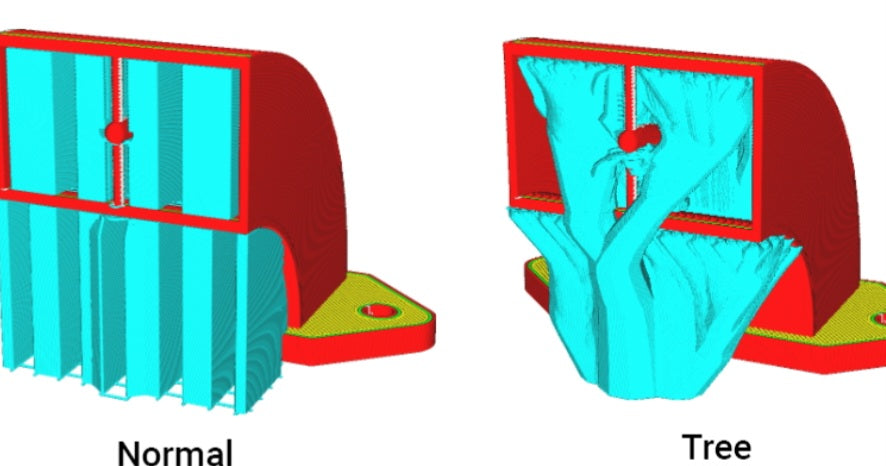
When 3D printing complex geometries with steep overhangs or floating features, support structures are essential for keeping your print from collapsing mid-air. However, removing rigid scaffolding can often leave behind ugly scars or ruin delicate surface finishes.
Choosing the right support style can drastically simplify post-processing and improve your overall print quality.
Tree Supports (Organic Supports)
Popularized by modern slicing software, tree supports grow upward like winding branches, using minimal contact points to cradle overhangs precisely where needed.
Best Used For:
Character miniatures, organic statues, complex artistic sculpts, and prints with intricate internal cavities.
Pros:
Consumes significantly less filament, prints much faster on complex geometries, and touches the model at very few targeted points, resulting in dramatically cleaner surface finishes after removal.
Cons:
Can occasionally snap off or fail on massive, heavy industrial overhangs if the base adhesion is not properly tuned.
Normal Supports (Linear/Grid Supports)
The traditional pillar-style scaffolding, normal supports build vertical straight-line columns directly up from the print bed to hold dangling sections.
Best Used For:
Flat architectural overhangs, mechanical brackets, geometric industrial parts, and steep bridge-heavy models.
Pros:
Provides rigid, rock-solid vertical support columns capable of holding up massive weighted sections without wobbling.
Cons: Uses a high volume of filament, increases total print time, and leaves extensive scarring across large sections of the model where the support fused against the outer surface.
Transitioning to organic branching structures minimizes surface blemishes and material waste, while traditional linear pillars remain reliable for heavy geometric weight-bearing setups.


