
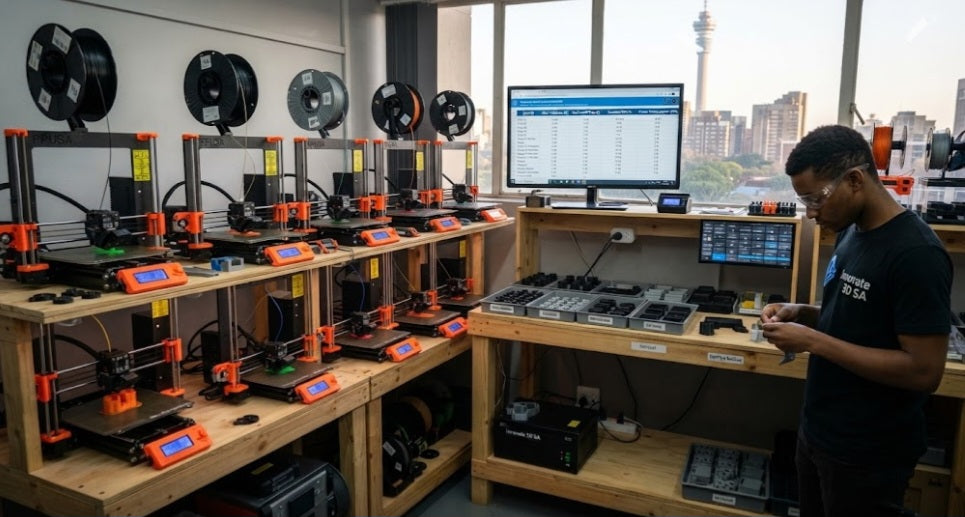
The allure of scaling up from a single hobbyist machine to a bustling, multi-printer operation is a common milestone for ambitious makers. Looking across a workbench filled with humming extrusion heads and glowing LCD screens feels like the threshold of a legitimate commercial enterprise. However, leaping blindly into expanding hardware without calculating real-world production metrics is one of the fastest ways to drain capital and exhaust operational bandwidth. For South African entrepreneurs, small studios, and independent workshop owners operating under tight margins, measuring throughput before launching a small 3D print farm is the ultimate safeguard against failure.
Calculating Actual Print Durations vs. Slicer Estimates:
Account for real-world variables like file slicing overhead, manual bed clearing times, and filament spool changeovers rather than relying purely on idealized software timers.
Evaluating Power Consumption and Load Stability:
Factor in local electrical utility rates, load-shedding battery backups, and continuous power draws across multiple running machines to predict overhead costs accurately.
Tracking Component Failure and Waste Ratios:
Measure your historical failure rate, material purge losses, and failed first layers to calculate actual net output versus gross filament consumed.
Mapping Peak Machine Utilization Rates:
Determine how many continuous hours per day your printers can realistically remain active without bottlenecking during post-processing or quality control.
Raw machine hours, establishing true throughput requires a clear-eyed look at the labor bottleneck that inevitably accompanies scaled production. A fleet of ten printers churning out parts simultaneously is useless if your single workbench cannot keep up with deburring, support removal, sanding, and assembly. By mapping out the entire operational pipeline—from raw G-code preparation to final packaging—operators can identify whether their constraint is hardware speed or manual post-processing capacity. Balancing these variables ensures your small print farm runs lean, profitable, and ready to scale sustainably.
Calculating realistic throughput demands a meticulous audit of your raw material supply chain and batch consistency. When scaling up production to fulfill bulk client orders, minor variations in filament diameter from spool to spool or shifts in ambient room temperature can trigger unexpected extrusion clogs and ruin entire multi-part print plates. Establishing standardized quality control checkpoints ensures that your farm does not waste expensive materials on undetected structural flaws early in the printing cycle.
Finally, integrating automated monitoring tools and remote management software can dramatically optimize your overall efficiency. Utilizing network-connected print servers allows operators to track live status updates, monitor print progress remotely, and quickly address failed prints before they compound into major losses. By combining rigorous capacity planning with smart automation, your small-scale print farm transitions from a chaotic collection of individual hobby machines into a streamlined, high-yield production facility.


