
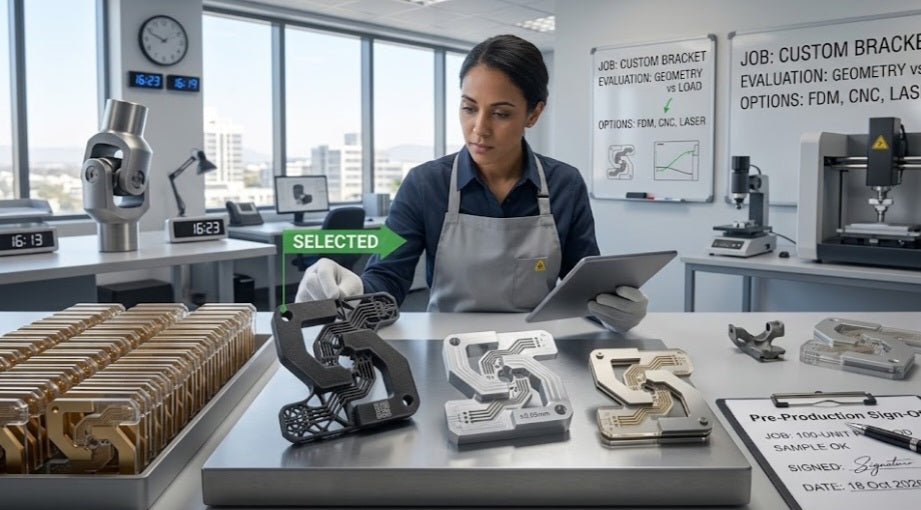
When a client walks into a modern digital fabrication bureau with a brand-new design concept or a broken mechanical part, they usually ask one fundamental question: "Can you make this for me?"
The real challenge for the shop owner isn't just answering whether it can be made—it's deciding which manufacturing technology will produce the part with the highest quality, strongest mechanical properties, and best profit margin in South African Rands (ZAR).
Should you fire up the FDM/SLA 3D printer, route it on the CNC router, or cut it on the laser cutter? Choosing the wrong production method leads to wasted raw stock, blown machine hours, and missed deadlines.
Here is your definitive workshop guide on how to evaluate custom jobs and select the exact right technology every time.
The Three Pillars of Digital Fabrication
Before diving into specific geometries, it helps to look at how each technology builds parts:
3D Printing (Additive):
Builds objects layer-by-layer from filament, resin, or powder. Excellent for complex internal channels, organic shapes, zero-tooling prototypes, and hollow structures.
Laser Cutting & Engraving (Subtractive 2D/2.5D):
Slices through flat sheet stock using a high-powered beam. Unbeatable for rapid 2D profiling, enclosures, stencils, signage, and intricate flat patterns.
CNC Machining / Milling (Subtractive 3D):
Carves solid blocks of metal, engineering plastics, or timber using rotating high-speed cutting tools. The undisputed king of structural strength, tight engineering tolerances, and true isotropic material properties.
Step-by-Step Decision Framework for Custom Jobs
Evaluate the Geometry: Is it 2D, Complex 3D, or Prismatic?
Choose Laser Cutting if the part is fundamentally flat with constant thickness throughout (e.g., brackets, gaskets, acrylic display stands, or chassis plates). Laser processing handles complex 2D contours at lightning speed.
Choose 3D Printing if the component features compound curves, internal undercuts, organic contours, or topology-optimized weight-reduction lattices that a cutting tool or laser beam physically cannot reach.
Choose CNC Machining if the part is a heavy-duty structural block requiring deep pockets, precise bearing seats, threaded fastener holes, and strict mechanical tolerances (\pm 0.05\text{ mm} or tighter).
Analyze the Mechanical Load and Material Requirements
Plastics & Prototypes:
If the client needs a lightweight, non-load-bearing visual prototype or enclosure, standard 3D printing filaments (PLA, PETG) or SLA resin save considerable time and cost.
High-Stress End-Use Parts:
If the component will experience severe mechanical torsion, high impact, or elevated temperatures (e.g., motor mounts, industrial brackets, or gears), 3D printed parts can suffer from layer delamination. Routing or milling them from solid engineering blocks (Nylon, Delrin, Aluminum, or Polycarbonate) guarantees maximum structural integrity.
Sheet Metal Fabrication:
When parts require high rigidity in thin profiles, laser cutting sheet steel or anodized aluminum is vastly superior to printing or milling.
Consider Batch Size and Production Economics
One-Off Prototypes:
3D printing is almost always the most cost-effective starting point because it requires zero custom fixturing or toolpath programming overhead.
Low-to-Medium Batches (10 to 100+ units):
Laser cutting excels here. Nesting dozens of flat parts onto a single sheet of acrylic or plywood maximizes material efficiency and cuts production time down to minutes per batch.
High-Precision Repeat Runs:
While CNC milling takes longer to program and set up, it produces thousands of identical, ultra-precise parts with repeatable dimensional accuracy that 3D printing cannot match at scale.
A Quick Reference Matrix for Your Shop Floor
Acrylic Enclosures & Signage:
Always Laser Cut.
Brackets & Mechanical Mounts:
CNC Mill (for high strength) or Laser Cut Sheet Metal (for production volume).
Miniatures, Figurines, & Complex Assemblies:
Always 3D Print (SLA for fine detail, FDM for durability).
Gaskets & Seals:
Laser Cut from silicone or rubber sheets.
Jigs, Fixtures, & Workshop Tooling:
3D Print with high infill (CF-Nylon or PETG) or CNC Route from HDPE.
Mastering the art of technology selection is what separates a professional fabrication bureau from an amateur hobbyist shop. By analyzing part geometry, mechanical loading requirements, and batch economics before hitting print or cut, you ensure maximum efficiency, flawless client satisfaction, and healthy profit margins.


