
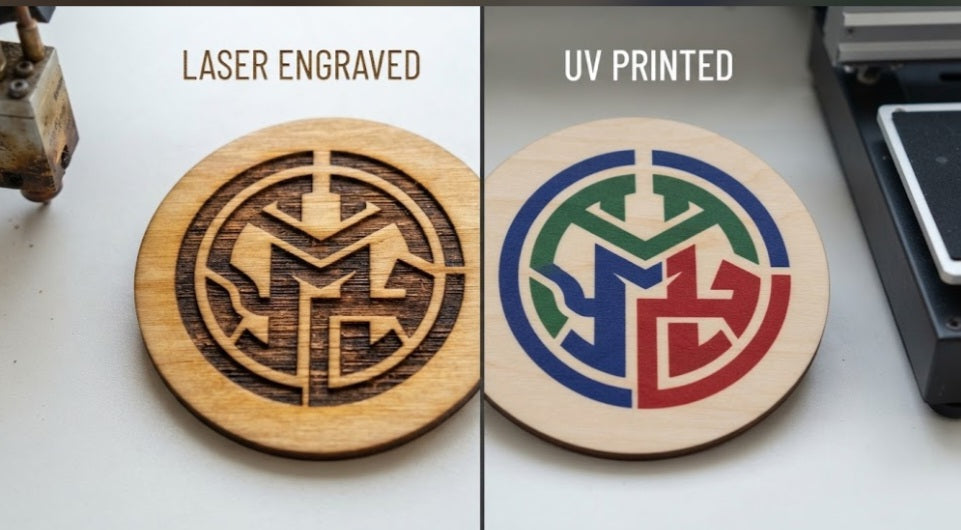
When you are running a custom fabrication and e-commerce business, choosing how to brand or decorate wooden items is one of the most critical decisions you will make. Whether you are crafting personalized wedding favors, branded corporate signage, custom chopping boards, or artisanal keychains, your customers expect a finish that withstands daily handling, sunlight, and wear. In the local maker space, two dominant techniques battle for supremacy: deep, tactile laser engraving and vibrant, full-color UV flatbed printing.
To settle the debate for South African creators, we put both finishes through a brutal series of durability tests—simulating harsh UV sunlight exposure, accidental moisture spills, and rigorous scratch resistance.
The Laser Engraving Advantage:
Burning artwork directly into the timber creates a permanent, carbonized indentation that cannot chip, peel, or rub off over time.
The UV Printing Appeal:
Laying down cured ink lets you achieve rich, full-color branding with incredible vibrancy, though the ink sits strictly on the surface of the wood.
The Environmental Test Factor:
South African workshops face unique climate challenges—from intense UV rays on the coast to rapid seasonal humidity shifts—making long-term finish testing essential.
Cost and Profitability:
Balancing equipment depreciation, ink costs, and time spent per piece directly affects your margins when selling in Rands.
Head-to-Head Durability: How They Hold Up
When a customer invests in a wooden decor piece, longevity is everything. To test real-world durability, we subjected test tiles of 3mm birch plywood and solid pine to three severe stress factors: accelerated UV fading, moisture exposure, and mechanical abrasion.
UV Sunlight Exposure:
UV flatbed inks initially look breathtaking with brilliant colors. However, under intense accelerated UV testing simulating months of direct South African sunlight, untreated or lower-quality UV inks can experience slight surface chalking or fading if a protective clear coat isn't applied. Laser engraving, by contrast, relies on the natural carbon burn of the wood; while the wood itself may patina under the sun, the engraving design remains permanently charred into the grain.
Moisture and Spills:
Kitchen items like wooden boards or coasters face regular liquid exposure. UV prints form a sealed plastic-like layer over the top of the wood, making them initially water-resistant. However, if water penetrates a microscopic edge chip, the ink can lift from the wood grain. Laser-engraved wood, when sealed with a good polyurethane or food-safe mineral oil (readily available at local hardware stores for around R150 to R300 per tin), repels moisture seamlessly because the design is part of the wood itself.
Scratch and Wear Resistance:
If a set of branded coasters gets stacked or shoved into a courier box, a surface-level UV print can suffer from micro-scratching if hard objects drag across it. Laser engravings are carved into the material, meaning even if the surrounding wood gets scratched, the graphic itself remains intact.
Surface vs. Sub-Surface:
UV printing offers stunning photographic color, but it lives entirely on top of the surface. Laser engraving cuts down into the fibers, offering indestructible permanence.
Maintenance Requirements:
UV printed items require gentle wiping, whereas laser-engraved and sealed wooden items can be easily re-oiled to look brand new years down the line.
Cost Analysis for South African Makers
When scaling up production, raw material and consumable costs dictate your retail pricing strategy. Let's look at how the numbers stack up in rands:
Consumable Costs:
UV printer inks can carry a steep upfront and ongoing replenishment cost, often running into thousands of rands for specialized white and CMYK cartridges. Laser engraving relies on electricity and occasional cleaning supplies, keeping per-item consumable costs extremely low (often mere cents per engraving).
Production Speed:
A 20W diode laser can batch-engrave dozens of wooden items in minutes, whereas a UV flatbed printer requires precise plate setup and curing passes. For high-volume, single-color personalization, laser engraving wins heavily on time efficiency.
The Final Verdict
If your product line relies heavily on vibrant, full-color photographs, logos with strict brand color palettes, or colorful kids' items, UV printing is unmatched. However, if you want to offer timeless, rustic, ultra-durable products that will never peel, scratch off, or fade—and you want to keep your production overhead low—laser engraving is the undisputed champion for rugged South African conditions.
Match your finish choice to your target market, price your items fairly in Rands to cover your electricity and machine maintenance, and watch your maker brand thrive!


