
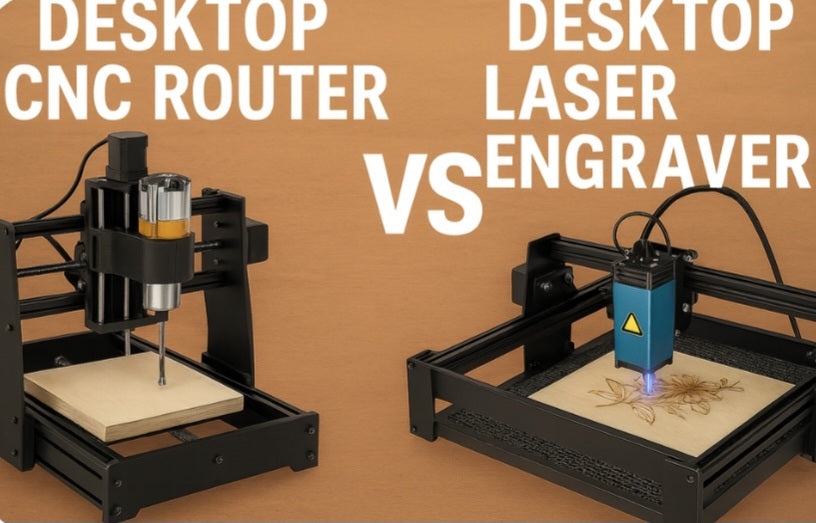
Whether you are expanding an existing workshop or launching a new custom fabrication business, choosing the right digital manufacturing equipment is a major milestone. Two of the most popular, versatile tools on the market today are Laser Engravers and CNC Routers.
While both machines read digital design files to cut and engrave materials automatically, they accomplish this in completely different ways. Picking the right one comes down to what products you want to sell, the materials you plan to work with, and the scale of your operations.
Let's break down how these two technologies compare so you can make the smartest investment for your business.
What is a Laser Engraver?
A laser engraver uses a concentrated, highly focused beam of light (typically from a Diode, CO2, or Fiber light source) to vaporize or burn away the surface layer of a material.
Key Strengths:
Unmatched Precision:
Lasers can render ultra-fine line work, intricate photorealistic photos, and microscopic text with extreme accuracy.
Non-Contact Processing:
Because no physical tool touches the workpiece, there is zero mechanical pressure. You don't need heavy clamps or vacuum tables to hold materials down.
Speed on Thin Materials:
Lasers rapidly engrave detailed patterns and cut through thin acrylic, wood, leather, or paper in seconds.
Limitations:
Depth Constraints:
Lasers excel at 2D cutting and surface engraving, but they cannot perform true 3D relief carving with varying depth profiles.
Material Thickness & Fire Hazards:
Cutting thick woods or plastics requires high power and slow speeds, often leaving charred or melted edges.
Fume Management:
Laser processing generates smoke and toxic volatile organic compounds (VOCs), requiring high-performance exhaust or filtration systems.
What is a CNC Router?
A CNC (Computer Numerical Control) router uses a high-speed spinning mechanical bit (similar to a drill bit or end mill) to physically carve and cut into solid stock.
Key Strengths:
True 3D Depth & Carving:
CNC routers can cut at precise variable depths, allowing you to craft 3D relief carvings, rounded bevels, bowl pockets, and mortise-and-tenon joints.
Handles Heavy & Thick Materials:
A CNC router easily slices through thick hardwoods, aluminum sheets, dense foam, MDF, and brass that a laser would struggle with or burn.
Clean, Unburnt Edges:
Because it uses mechanical cutting rather than heat, a CNC router leaves natural, un-charred wood edges.
Limitations:
Corner Radius Limitations:
Because cutting bits are round, a CNC router cannot create perfectly sharp, 90-degree internal corners without specialized bits or post-processing.
Noise & Dust:
CNC machines generate significant noise and large volumes of saw dust, requiring industrial shop vacuums and ear protection.
Steeper Setup Curve:
Securing workpieces requires clamps, double-sided tape, or vacuum tables, and toolpaths require careful planning to prevent bit breakage.
When comparing their cutting methods, a laser engraver utilizes a thermal light beam, whereas a CNC router uses a mechanical spinning bit. For intended uses, a laser engraver is best suited for fine details, thin cuts, and surface markings, while a CNC router handles thicker stock, 3D relief, and structural items.
Regarding edge finishes, lasers leave acrylic clean and wood scorched or darkened, whereas routers produce natural, clean wood edges with sharp tool marks. Finally, in terms of material thickness, lasers perform best under 10mm to 15mm, while CNC routers easily handle several inches of thick stock.
Which Machine Should Your Business Choose
Choose a Laser Engraver if your business model focuses on:
Personalization & Gifts:
Custom tumblers, photo-engraved wooden plaques, leather wallets, keychains, and wedding favors.
Intricate Crafts & Displays:
Detailed acrylic nightlights, paper artwork, thin plywood ornaments, or intricate rubber stamps.
High-Volume Marking:
Rapidly adding logos, serial numbers, or barcodes onto pre-manufactured goods.
Choose a CNC Router if your business model focuses on:
Furniture & Cabinetry:
Making chairs, tables, cabinets, nested plywood furniture, or custom shelving.
Large-Format Signage:
Carved 3D wooden signs, dimensional lettering, and outdoor architectural decor.
Prototyping & Aluminum Fabrication:
Machining thicker aluminum parts, mold making, guitar bodies, or heavy wood carving.
Can't Decide? Consider the Hybrid Approach
Many thriving workshop businesses eventually own both. A common production workflow is using a CNC router to cut heavy wooden stock into structural shapes, and then using a laser engraver to add intricate branding, text, or fine artwork to the finished product.


