
Choosing the right substrate can make or break your laser-cutting projects. Whether you are running production batches for your online shop or crafting intricate custom orders, your choice of material directly affects cutting speed, edge quality, post-processing time, and structural durability.
Two of the most popular sheet materials for laser cutting are Medium-Density Fiberboard (MDF) and Plywood (specifically laser-grade varieties like Baltic Birch). While both are widely accessible, they behave very differently under a laser beam.
Here is a breakdown of how they compare across key categories to help you decide which one deserves a spot in your inventory.
Composition and Structure
Composition and Structure
Plywood:
Made by layering thin sheets (veneers) of wood wood stacked cross-grain and bonded together under heat and pressure. High-quality laser plywood features void-free inner plies and uniform thickness.
MDF: Manufactured by breaking down hardwood or softwood residuals into wood fibers, combining them with wax and resin binders, and compressing them into a dense, uniform panel. It has no grain pattern.
Laser Cutting and Engraving Performance
Cutting Edge & Charring
Plywood:
Generally cuts cleanly with minimal residue, provided you use low-resin, laser-safe glues. The edges exhibit natural wood grain lines, which many customers find aesthetically pleasing.
MDF:
Because it lacks grain, MDF cuts uniformly in any direction. However, the high glue-to-fiber ratio often results in darker, sootier edge charring and produces significantly more smoke during the cut.
Engraving
Plywood:
Engraving can yield variable results depending on the surface veneer's grain pattern and the presence of underlying glue pockets. Harder grain lines engrave lighter, while softer areas burn deeper.
MDF:
A clear winner for flat, detailed surface engraving. Its uniform density produces consistent, high-contrast, deep brown engraving depths across the entire panel.
Strength, Weight, and Durability
Plywood (The Structural Champ):
Cross-graining gives plywood exceptional tensile strength and dimensional stability. It resists warping, handles drops well, and holds mechanical fasteners (like screws or tight finger joints) securely.
Mdf (The Heavyweight):
MDF is significantly heavier than plywood of the same thickness. It lacks structural flexibility—meaning it snaps easily under stress rather than bending—and its edges tend to crumble if used with tight, load-bearing finger joints. It also swells irreversibly if exposed to moisture.
Safety and Workshop Maintenance
Ventilation and Extraction:
Both materials require good ventilation, but MDF is harsher on extraction systems. It generates heavy, fine dust during cutting that quickly cakes up honeycomb beds and clogs air filters.
Chemical Binders:
Standard commercial MDF and construction-grade plywood use urea-formaldehyde resins that release toxic, irritating fumes when vaporized by a laser. Always look for formaldehyde-free or specially rated "laser-safe" MDF and low-emission plywood to protect your respiratory health and your workshop.
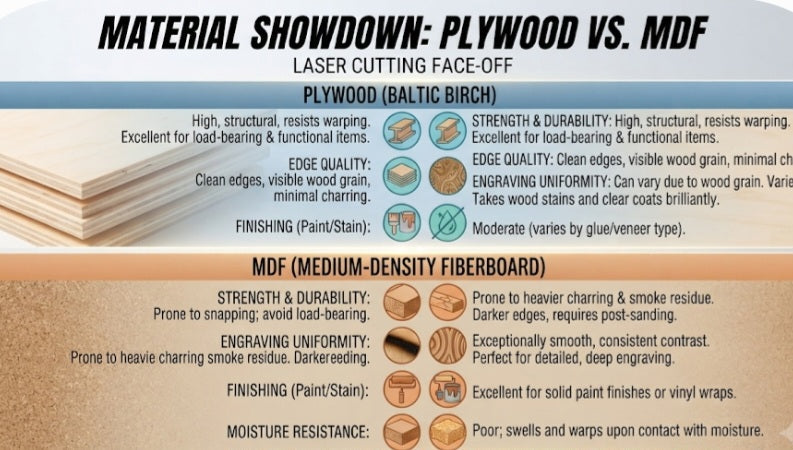
When comparing MDF to plywood for laser cutting, each material offers distinct advantages depending on your project goals. Plywood excels in structural strength and durability, making it ideal for load-bearing and functional items with clean edges and appealing wood grain aesthetics, though its engraving uniformity can vary due to the natural grain.
On the other hand, MDF provides consistent, smooth engraving and a uniform surface, but it is less durable with lower strength under stress and is prone to heavier charring and smoke residue during the cutting process.
Final Verdict: Which Should You Choose?
Choose Plywood if:
You are building functional products, boxes, structural displays, intricate geometric art, toys, or items that need structural integrity and longevity. For most laser businesses, 3mm Baltic Birch is the gold standard.
Choose MDF if:
You are prototyping a design on a tight budget, creating smooth, painted signage, making architectural models, or working on flat decorative panels where a uniform, paint-ready surface matters more than physical strength.


