
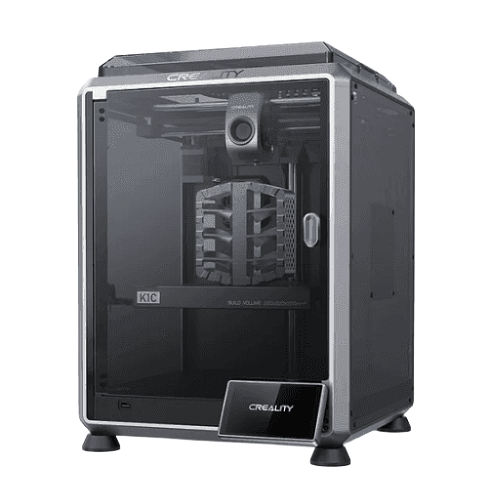
Many hobbyist machines ship as "open-frame" designs, which are perfectly sufficient for standard materials. However, as you move toward more advanced engineering filaments or encounter environmental challenges in your workspace, an enclosure becomes a critical upgrade.
Determining whether your setup requires a controlled environment depends largely on the materials you use and the conditions of your room.
Printing Warp-Prone Materials (ABS, ASA, Nylon)
If you are working with high-performance plastics like ABS, ASA, or Nylon, an enclosure is not optional—it is a necessity.
Why It Is Needed:
These materials are highly sensitive to thermal contraction. Without a steady, warm ambient temperature provided by an enclosure, the layers cool unevenly, leading to "warping" at the corners or "splitting" (delamination) between layers.
The Benefit:
A sealed chamber traps heat generated by the heated bed, maintaining a consistent air temperature that allows the plastic to cool slowly and uniformly.
Dealing with Drafty Environments
Environmental factors outside the machine often cause print failures that have nothing to do with your settings.
Why It Is Needed:
If your printer is located near an air conditioner, an open window, or in a high-traffic area, cold air currents will hit your print mid-process. Even a mild draft can cause sudden temperature fluctuations that result in uneven layers or warping.
The Benefit:
An enclosure creates a stable micro-climate, shielding your model from external air currents that would otherwise sabotage the print.
Controlling Particulate and Odors
Beyond structural print quality, enclosures offer significant health and safety benefits.
Why It Is Needed:
Certain filaments, especially ABS, emit volatile organic compounds (VOCs) and ultrafine particles when melted.
The Benefit:
An enclosure allows you to filter the air before it exits the machine (if equipped with a HEPA/carbon filter) or vent the fumes outside, keeping your immediate breathing environment safer and reducing the smell of melting plastic.
Adding a climate-controlled chamber solves the most common issues associated with advanced material deformation and environmental instability, ensuring reliable results for high-temperature projects.


