
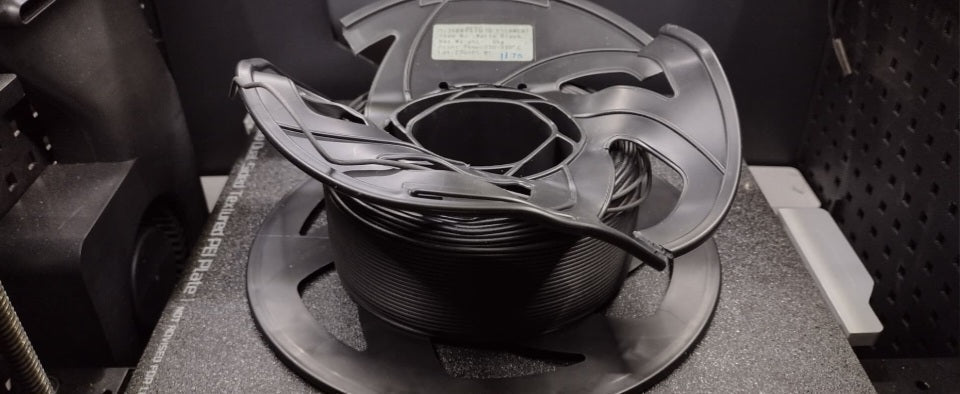
If you have ever spent hours tuning your 3D printer, calibrating your first layer, and perfecting your slicer settings, only to watch your print ruined by sudden bubbling, sizzling sounds, and weak, stringy layers, you have likely encountered the silent enemy of 3D printing: moisture.
While standard materials like PLA can sometimes tolerate a bit of humidity, advanced engineering filaments—and even everyday plastics left out too long—suffer drastically when they absorb water from the air. Enter the filament dryer: an accessory that has quickly evolved from an optional luxury to an absolute necessity for serious makers.
In this comprehensive guide, we will break down exactly what a filament dryer is, how moisture ruins your prints, why passive storage isn't always enough, and whether you truly need one for your specific 3D printing workflow.
What Exactly Is a Filament Dryer?
At its core, a filament dryer is a specialized appliance designed to store and actively dehydrate 3D printer filament spools. Unlike a standard kitchen food dehydrator (which many makers repurposed in the early days of the hobby), modern filament dryers are purpose-built for the unique dimensions of 3D printer spools.
Most commercial filament dryers feature:
Controlled Heating Elements:
They gently warm the air inside the chamber to a precise temperature (usually between 40°C and 70°C), which is hot enough to drive moisture out of the plastic winding without reaching the glass transition temperature that would fuse the spool together.
Internal Air Circulation Fans:
Built-in fans circulate the warm air evenly around the spool, ensuring moisture doesn't just get trapped inside the enclosure.
Humidity and Temperature Displays:
Digital hygrometers let you monitor the internal relative humidity (RH) levels in real time.
Sealed Feed-Through Ports:
Many models allow you to feed the filament directly from the dryer straight into your printer's extruder, keeping the spool completely dry while you print.
Why Does Filament Absorb Moisture? (The Hygroscopic Threat)
To understand why a dryer is necessary, you first need to understand how filament behaves. Almost all commonly used 3D printing polymers—including Nylon, Polycarbonate (PC), TPU, PETG, ABS, and even PLA—are hygroscopic.
The Sponge Effect:
This means their molecular structure naturally attracts and absorbs moisture molecules from ambient air humidity.
The Boiling Point Disaster:
When you feed wet filament into a hotend operating at 220°C to 300°C, that trapped water instantly flashes into steam. As the molten plastic exits the nozzle, microscopic pockets of steam violently expand, causing:
Popping and Sizzling:
Audible sounds coming straight from your heater block.
Surface Pitting and Stringing:
Blobs, zits, and inconsistent extrusion lines.
Brittle Layers:
Steam bubbles compromise the internal bond between layers, causing the printed part to snap easily under minimal stress.
Dry Boxes vs. Filament Dryers: What is the Difference?
A common point of confusion for beginners is the difference between dry storage and active drying.
Dry Boxes (Passive Storage):
These are airtight containers (like modified plastic storage bins, gasket-sealed cereal boxes, or dedicated spool enclosures) packed with rechargeable silica gel desiccant. Their job is maintenance. A good dry box stops dry filament from absorbing new moisture, but it cannot remove moisture from a spool that is already wet.
Filament Dryers (Active Dehydration):
These use heat and airflow to actively bake existing moisture out of a soaked spool.
Think of a dry box as a refrigerator that keeps your food fresh, and a filament dryer as an oven that cooks raw ingredients. You often need both: dry a wet spool in the dryer, and then store it in a dry box (or keep it running in an active dryer while printing).
Do You Really Need a Filament Dryer
The short answer is:
It depends entirely on the materials you print and your local climate. Here is how to evaluate whether you need to invest in one:
You Definitely Need One If:
You print with engineering filaments:
If you regularly work with Nylon or Polycarbonate (PC), a dryer is non-negotiable. These materials absorb moisture from the air within hours—sometimes even mid-print. Printing them without active drying almost always results in structural failure.
You live in a humid climate:
If your workshop or home experiences high relative humidity (coastal areas, tropical regions, or rainy seasons), ambient moisture will quickly compromise your spools, even if they are left out for just a weekend.
You print flexible filaments (TPU):
TPU acts like a rubber sponge. Wet TPU prints with excessive stringing and loses its elasticity and impact resistance.
You notice unexplained print failures:
If you are seeing sudden layer adhesion drops, brittle prints, or rough surface textures on materials like PETG or PLA that used to print perfectly, moisture is usually the culprit.
You Might Skip It For Now If:
You live in an arid, bone-dry climate:
Makers in desert environments rarely struggle with ambient humidity.
You exclusively print standard PLA in short bursts: If you open a roll of basic PLA, print a small model quickly, and immediately seal it back up in a bag with desiccant, you can often get away without a dedicated dryer.
Best Practices for Using a Filament Dryer
If you decide to pick up a filament dryer, follow these tips to get the best results:
Know Your Temperatures:
Don't overheat your plastic! PLA only needs around 40°C to 45°C, whereas Nylon and Polycarbonate can handle 65°C to 70°C safely. Setting the temperature too high will weld your spool turns into a solid, unprintable block.
Dry Before You Print:
Give a suspected wet spool at least 4 to 12 hours in the dryer before starting a critical print job.
Print Directly From It:
For hygroscopic engineering materials, use a dryer that features top feed holes so you can print directly out of the heated enclosure.
Mastering advanced engineering filaments like nylon and polycarbonate ultimately hinges on rigorous preparation and environmental control.
Because these high-performance materials are exceptionally hygroscopic and prone to severe thermal contraction, achieving industrial-grade results requires treating your hardware and workflow with equal precision.
By pairing an all-metal hotend and high-temperature heated bed with a fully enclosed chamber, specialized build plate adhesives, and a dedicated active filament dryer, you eliminate the common failure points of moisture degradation and warping.
Investing in these essential tools transforms difficult engineering polymers from a frustrating trial-and-error process into reliable, ultra-durable functional prints.


