
The Ultimate Guide to Mastering Extrusion Timing, Sharp Corners, and Flow Dynamics
When you push a modern 3D printer to its limits—utilizing high-speed firmware like Klipper, aggressive acceleration profiles, and fast volumetric flow rates—you quickly run into a subtle yet destructive hydraulic problem: oozing, bulging corners, and starved line starts.
Even if your belts are tensioned like guitar strings and your input shaping has completely eliminated mechanical ringing, your prints can still suffer from bloated, rounded corners and ugly gaps right after a sharp directional turn. This occurs because molten plastic behaves like a compressible fluid inside a hot nozzle, not like a solid wire.
To solve this, advanced firmware uses a feature known as Pressure Advance (sometimes called Linear Advance in Marlin).
Throughout this article, we will break down the fluid dynamics of extrusion, explain how pressure builds and decays inside your hotend, and show you why mastering pressure advance is the secret to achieving razor-sharp professional print quality at high speeds."
The Fluid Dynamics of a Hotend: Why Plastic Behaves Like a Spring
To understand why pressure advance is necessary, you have to look at what physically happens inside your hotend during a print move.
The Compressibility of Molten Polymer:
When your extruder gears push filament into the melt zone, the plastic inside the heatbreak and nozzle is under significant hydraulic pressure. Plastic is slightly compressible, and the long melt chamber acts like a hydraulic accumulator or a spring storing potential energy.
The Pressure Lag Problem:
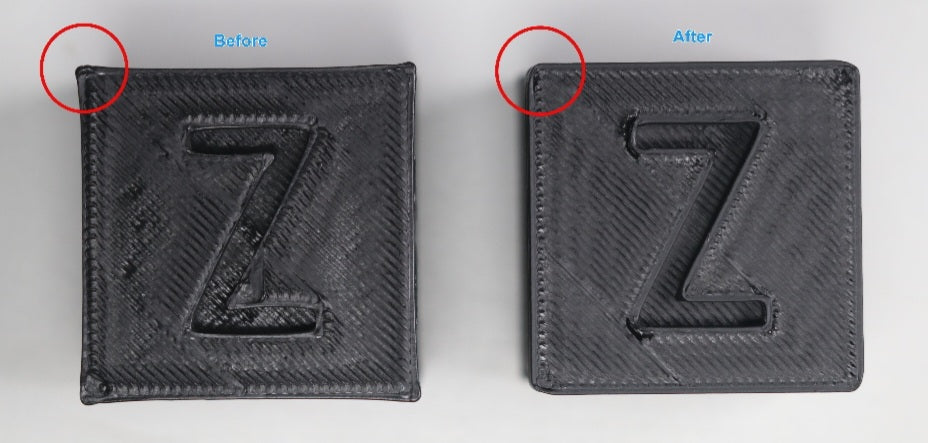
When your print head approaches a sharp 90^\circ corner, it must decelerate to make the turn. However, if the extruder gears stop pushing at the exact same rate, the pressurized plastic remaining inside the nozzle continues to ooze out under its own stored pressure. This results in an over-extruded blob or a rounded, bulging corner.
The Starved-Line Recovery:
Conversely, when the nozzle accelerates away from that corner to start printing a fresh line again, the extruder gears must ramp up pressure from scratch. Because it takes a split second to re-pressurize the melt zone, the printer lays down a thin, under-extruded, or completely missing segment of plastic right at the beginning of the line.
How Pressure Advance Works Its Magic
Instead of treating extrusion as a static volume where flow rate matches print speed 1:1, pressure advance introduces dynamic compensation based on acceleration and velocity.
Predictive Flow Adjustment:
The firmware continuously monitors how fast the print head is accelerating or decelerating.
Proactive De-Pressurization (Unretraction/Retraction on the Fly):
When the toolhead approaches a deceleration zone (like a corner), the firmware momentarily reverses the extruder gears ahead of time to bleed off excess pressure in the nozzle. This stops the ooze before it happens, keeping corners crisp and square.
Instantaneous Re-Pressurization:
As the toolhead accelerates out of a corner, the extruder gears give a sudden, calculated burst of extra filament feed, instantly packing the melt zone back to operating pressure so the outgoing line starts thick, crisp, and fully bonded right from the very first micron.
The Real-World Impact: What Changes on Your Prints
Tuning your pressure advance value transforms the geometric precision of your functional and aesthetic prints.
Razor-Sharp Corners:
Outer walls remain straight and true right up to the vertex, eliminating the rounded "dog-ear" blobs that ruin tight tolerances and snap-fit assemblies.
Clean Seams and Retractions:
By keeping internal nozzle pressure precisely regulated during travel moves, oozing is minimized without needing excessively long, string-inducing mechanical retractions.
Uncompromised High-Speed Flow:
You can maintain high printing velocities without sacrificing dimensional accuracy, as the firmware dynamically scales extrusion pressure relative to acceleration spikes.
Pressure advance bridges the gap between mechanical motion and fluid dynamics in high-speed 3D printing. By predicting how molten polymer stores and releases hydraulic pressure inside the hotend, this vital firmware feature eliminates corner blobs and starved starts, empowering your machine to lay down clean, crisp, engineering-grade geometry at any speed.


