
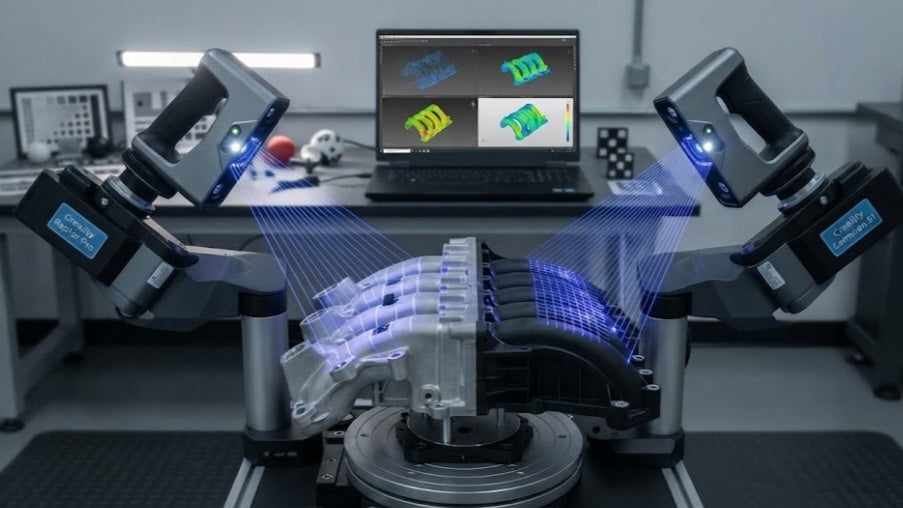
When putting professional 3D metrology equipment to the ultimate test, the true measure of performance is how two distinct hardware ecosystems handle the exact same complex workpiece. Imagine mounting a complex aluminum-and-composite automotive intake manifold on a rotary turntable, then attempting to capture every internal contour, sharp fillet, and smooth transition using two high-end handheld blue-laser systems: the Creality Raptor Pro and the Creality Sermoon S1. On paper, both units promise metrology-grade precision and high frame rates, but their internal optical architecture, laser line densities, and lens configurations yield remarkably different workflow experiences in practice.
Evaluating how a hybrid blue-laser and infrared system compares against an advanced multi-line array on identical geometry reveals critical insights for reverse engineering. Let's break down the direct performance comparison between these two powerful scanning platforms.
Laser Line Density and Coverage:
The Raptor Pro utilizes a 22 cross-line blue laser array paired with 7 parallel fine lines, while the Sermoon S1 steps up to a heavy-duty 34 cross-line configuration alongside specialized single-line and parallel modes.
Frame Rate and Data Throughput:
The Raptor Pro pushes up to 60 FPS at 660,000 points per second, whereas the Sermoon S1 accelerates data capture up to 90 FPS reaching 1.4 million points per second.
Handling Complex Transition Geometries:
Testing the same part highlights how effectively each scanner transitions from wide area feature sweeps down to tight, deep-pocket geometry without losing tracking lock.
Software Processing and Mesh Stitching:
Moving data from device-specific capture software into CAD pipelines exposes differences in point cloud noise suppression and automatic hole-filling algorithms.
Step-by-Step Comparative Testing Protocol
Executing a fair side-by-side benchmark test on a single industrial component requires a rigid, repeatable testing methodology.
Part Preparation and Baseline Setup:
Mount the target part securely on a stable, vibration-damped turntable. Apply global tracking markers strategically around the fixture table rather than directly cluttering the test part's functional surfaces.
Executing the Raptor Pro Scan Run:
Initiate the scan using the Raptor Pro's 22 cross-lines for fast surface coverage, then switch to its 7 parallel lines for fine-detail fillets. Note how smoothly the near-infrared (NIR) mode captures surrounding color texture if required.
Executing the Sermoon S1 Scan Run:
Without altering the part position, clear the workspace and scan the identical component using the Sermoon S1's dense 34-line cross laser setup. Utilize its dedicated single-line laser mode specifically targeted at deep, recessed bolt holes and internal channels.
Comparative Point Cloud Analysis:
Export both raw point clouds into metrology inspection software (such as Geomagic Control X or PolyWorks) to evaluate deviation heatmaps, point density consistency, and edge sharpness.
Evaluating Tracking Stability:
Compare how each device maintains lock when sweeping rapidly across high-contrast transitions between matte black polymer brackets and shiny metallic inserts.
Post-Processing Workload:
Measure the time required in software to clean stray artifact points, align multiple scans, and generate a watertight, CAD-ready polygon mesh suitable for direct solid modeling.
Advanced Optical Interference and Data Fidelity
Raw point rates and laser counts, a head-to-head evaluation is heavily influenced by how each sensor handles localized ambient lighting and high-frequency vibration noise. Handheld metrology requires human operators to sweep the sensor manually, introducing subtle hand tremors that can blur high-resolution frames if the exposure time is too long. The Sermoon S1's higher frame rate (90 FPS) inherently minimizes motion blur during rapid sweeps, whereas the Raptor Pro relies heavily on optimized exposure algorithms to maintain sharp line crispness under varying shop lighting. Understanding these subtle hardware nuances ensures that engineers select the ideal tool for high-precision reverse-engineering tasks where micron-level accuracy dictates final part success.
Comparing the Creality Raptor Pro and the Sermoon S1 on the exact same mechanical part demonstrates that hardware choice depends entirely on your specific workflow priorities—balancing ultra-fast point density acquisition against specialized deep-recess laser configurations. By understanding their distinct optical limits, you can optimize your scanning protocols for flawless metrology results.


